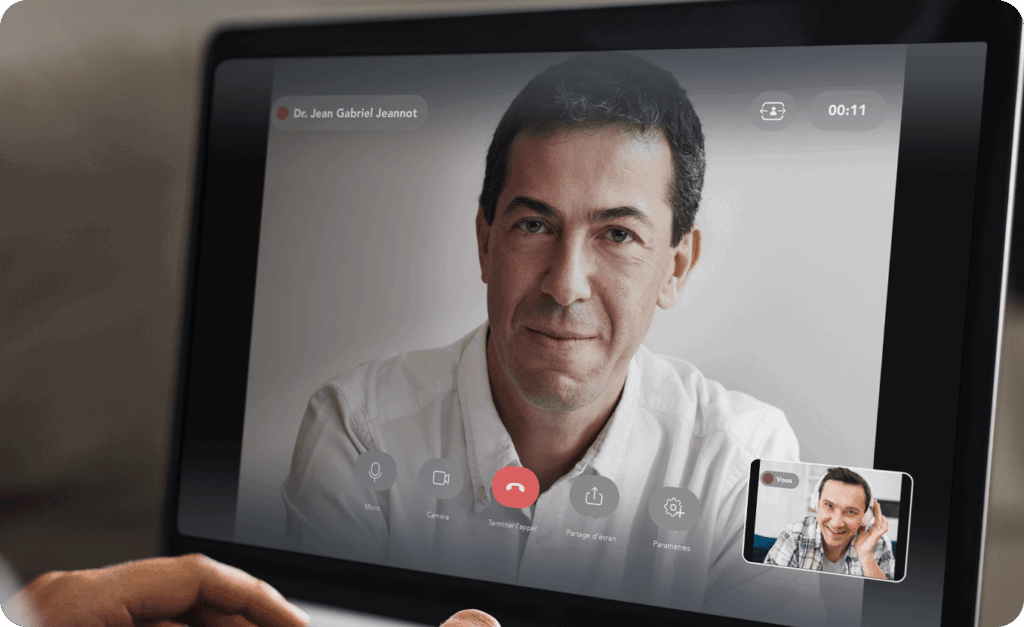
A few years ago, OneDoc launched its teleconsultation module. Originally designed as an emergency solution during the COVID-19 pandemic, it quickly established itself as a real alternative to in-person consultations.
Continuity of care, proximity, and simplicity: Discover how Dr. Jean Gabriel Jeannot, specialist in General Internal Medicine in Neuchâtel, has integrated video into his daily practice.
Maintaining the doctor–patient connection: a necessity born during the COVID-19 pandemic
When the COVID-19 pandemic hit, many practices were forced to close their doors. Doctors could only see their patients on very rare occasions. Dr. Jeannot, who was already used to communicating by phone or email, was looking for a way to continue providing care without losing the human connection.
There was a period at the beginning of the pandemic when doctors could only see their patients in the practice in very rare situations. Some of my colleagues didn’t even go to their practice anymore – they had no contact with their patients. I was lucky enough to continue working almost normally, but remotely.
For him, remote consultation is not a new idea: he already recognized its value before the pandemic. But he lacked a reliable framework – secure and easy to implement.
Even before the pandemic, I had started communicating with my patients by phone and email – whenever an in-person consultation was not necessary.
This need for continuity, efficiency, and proximity naturally led him to video consultation.

An integrated, secure, and easy-to-use video module as an answer to this need
At the height of the crisis, OneDoc integrated a video consultation module directly into the calendar. For Dr. Jeannot, this solution came at just the right time.
From a practical point of view, it was very simple because OneDoc offered a video solution integrated into its calendar right from the beginning of the pandemic.
The setup is immediate: no installation, an intuitive interface, and above all, a solution already compliant with Swiss medical standards.
Within a few days, Dr. Jeannot added the video option to his daily consultations.
During that time, I added video consultation to my practice. At first, I was hesitant since I wasn’t used to talking to my patients by video – but then I realized that this way of treating really adds value and strengthens proximity with the patient.
Today, he reserves specific time slots for video consultations in his OneDoc calendar, giving his patients the choice between in-person or remote appointments:
I have reserved several time slots per week for video consultations in my calendar. For me, the standard consultation remains in-person, but I want my patients to have a choice.
OneDoc also supports this transition with online appointment booking, secure data exchange, and a responsive technical support team for practitioners.
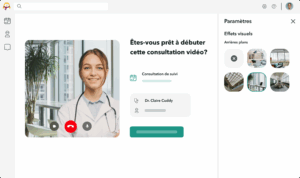
Discover the OneDoc Visio features

Between continuity of care and new proximity with patients: convincing results for Dr. Jeannot
With OneDoc, Dr. Jeannot was able to ensure continuous follow-up while opening new perspectives for his practice. Video consultation has not proven to be a temporary solution but rather a complementary approach:
Even though nothing will ever replace physical contact between caregiver and patient, there are many situations where a physical examination is not necessary. People often view teleconsultation as ‘second-class medicine’, but I think that’s wrong.
For his patients, flexibility has also become essential:
My patients who book video appointments mostly do so for practical reasons – because coming to the practice takes too much time or is complicated. I’m thinking, for example, of a single mother of three young children whom I recently saw via video – coming to the practice would have been a real challenge for her.
Video consultation therefore makes it possible to maintain a human connection while adapting care to everyday life.
Dr. Jeannot also uses it for the follow-up of chronic conditions, alternating with in-practice visits.
The OneDoc video consultation is particularly useful for the follow-up of my patients with chronic diseases, alternating with in-person consultations.
In summary, for Dr. Jeannot, video consultation is a model for the future. Initially a response to a crisis situation, this practice has become established and aims to expand further, offering greater flexibility and easier access to healthcare for both patients and professionals.