
Billing according to Tarif 590 is mandatory for all therapists recognized in Switzerland. This standard, established by the insurers, ensures consistent and harmonized billing for healthcare services. Whether you are just getting started or simply want to better understand the elements of a compliant invoice, this guide details the structure of a Tarif 590 invoice and how to fill it out to avoid reimbursement errors.

Reminder: The Basics of Tarif 590
Tarif 590 is an official invoice format defined by Swiss insurers. It ensures that all invoices issued by therapists follow the same structure and coding system, making them easier to read and validate.
- Why is Tarif 590 mandatory?
It standardizes exchanges between therapists, patients, and insurers. If a discrepancy or formatting error occurs, a health insurance company may reject the invoice. - Who is concerned by Tarif 590?
All therapists accredited by organizations such as ASCA or RME, as well as other practitioners whose activity is recognized by supplemental insurers.
The General Structure of a Tarif 590 Invoice
A compliant Tarif 590 invoice consists of five main parts:
- Information about the therapist (invoice issuer)
- Information about the patient
- Case details (diagnosis, type of treatment, remarks)
- Billable services (positions, quantities, amounts)
- A summary and the total amount
Each section has a specific purpose and must be completed carefully.
1. Information About the Therapist
This first section clearly identifies the professional issuing the invoice.
Fields to complete with your information:
- Name, full address, postal code
- RCC number (Creditor Code Register): identifies the therapist to insurers.
- GLN number (Global Location Number): if applicable, specifies the professional address.
- Invoice identification number: automatically generated and must be unique for each invoice.
These details ensure traceability and allow insurers to match the provider with the official registry.
2. Information About the Patient
This section includes the elements necessary for identifying the patient and understanding the billing context.
Required patient information:
- Name, address, date of birth
- Applicable law (default: VVG, Insurance Contract Law)
 The applicable law may vary depending on the case: accident (UVG), military (MV), etc. If accident insurance is used, you must also include the case date.
 - Treatment dates
- Reimbursement type:
- Tiers Garant (TG): the patient pays the invoice and gets reimbursed by the insurer.
- Tiers Payant (TP): the insurer pays the therapist directly (less common).
These fields determine how and by whom the invoice will be paid (patient or insurer). Errors may cause reimbursement delays.
3. Case Details and Diagnosis
This section provides contextual details about the treatment without excessive medical information.
Commonly filled fields:
- Referring physician: if applicable.
- Diagnosis: short description of the reason for consultation (e.g., neck pain, headaches).
- Type of therapy (individual or group).
- Tariff point value (TPV): generally set to 1.00.
- Remarks: useful notes for the insurer (e.g., “treatment completed” or “additional sessions planned”).
The diagnosis should remain concise and not medically detailed. Its purpose is to provide context — not a medical record.
Discover all our solutions related to Tarif 590 billing

4. Billable Services
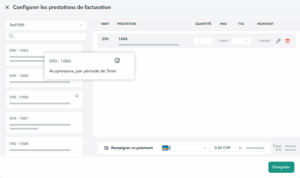
This is the core of the invoice. Each service must be listed according to Tarif 590, which includes more than 100 therapeutic methods with numbered positions. If you are an ASCA therapist, you can consult our correspondence table to determine which tariff applies to your services.
Fields to complete:
- Date of the service
- Tariff code (e.g., 1004, acupuncture per 5-minute unit)
- Quantity (number of 5-minute units)
- Unit price
- Total amount = Quantity × Price
- VAT (0% if exempt, otherwise applicable rate)
Example:
A 60-minute acupuncture session → 12 × 5 minutes × CHF 10 = CHF 120
Always ensure you use the official tariff codes without modification.
5. Summary and Total Amount
This final section concludes the invoice with the total cost of services.
It includes:
- Gross total
- VAT (if applicable)
- Final amount to be paid
In most cases, these amounts are automatically generated by your billing tool based on the entered services.

The Structure of a Tarif 590 Invoice in Brief
Tarif 590 billing is based on a simple but precise structure. While it is useful to understand every part, you do not need to know every detail if you use digital tools to automatically generate your invoices and send them securely to your patients.