
Patient acquisition has fundamentally changed in recent years. Patients in Switzerland now inform themselves digitally, compare offers, and often make their decisions before even having their first contact with a doctor. For healthcare professionals, this means: successful patient acquisition happens where decisions are made – online and locally.
This guide shows you in a practical way how patient acquisition works in Switzerland today, from the fundamentals to digital channels, offline initiatives, and KPIs (key performance indicators).
What is meant by patient acquisition?
Patient acquisition includes all measures aimed at attracting new patients as well as retaining existing patients in the long term. In the past, a few word-of-mouth recommendations and a practice sign were sufficient. Today, patient acquisition is a true strategic process.
Changes in patient behavior are shaping this shift. Most people research online, read reviews, and expect digital services such as online appointment booking. Trust is increasingly built before the first visit to the practice – via the website, the OneDoc profile, the Google listing, and online reputation.
The consequence is clear: practices must be visible and convincing where patients compare and make decisions.
How can you attract new patients?
Attracting new patients today means intelligently combining multiple channels. Online and offline strategies intertwine and reinforce each other.
The essential pillars are:
- A professional online presence
- Local visibility in search engines
- A simple and digital booking process
- Building trust through reviews and content
- Regional networking and referrals
The key is not isolated measures, but to build a coherent overall system.
Here are the key steps for strategic patient acquisition:
1. Create and manage a Google Business Profile
The Google Business Profile is one of the most important levers for patient acquisition. It appears directly in Google Search and on Google Maps (often even before the website) and gives patients a quick overview of your practice, services, and contact details.
An optimized profile:
- increases local visibility
- provides quick information
- builds trust through reviews
- generates calls and appointment bookings
Important measures:
- Claim the profile and complete it fully
- Keep opening hours and services up to date
- Upload high-quality photos
- Use posts and updates
- Actively respond to questions in the Q&A section
- Manage reviews professionally, stay in touch with patients, and build trust
 Did you know?
OneDoc Pro’s online booking is integrated into the “Book online” button of your Google Business Profile. This allows you to directly convert Google searches into appointment bookings!
2. Online appointment booking and process communication
24/7 online appointment booking significantly lowers barriers for new patients, as many appointments are now booked outside of regular practice hours.
Benefits of online booking for your practice:
- more bookings
- reduced phone workload
- better planning
- lower no-show rate
SMS reminders and email appointment confirmations measurably reduce missed appointments. Practices often report that up to 50% of appointments are booked digitally once the process is clearly communicated.
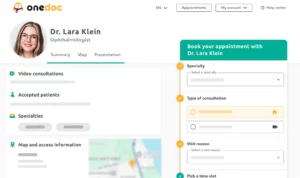
Use OneDoc Pro tools for patient acquisition

3. Offer telemedicine
The use of video consultations enables new first contacts and addresses patient groups who would otherwise not visit the practice, for example because they live farther away or are unable to travel. It lowers barriers, creates flexibility, and differentiates your practice from competitors.
Success factors for video consultations:
- Seamless integration into your schedule
- Clear communication of services
- Professional, data-protection-compliant tools
This is a particularly attractive element of modern patient acquisition, especially for initial consultations or follow-up appointments.
4. Content and social media: building trust
High-quality content on your social media platforms puts your patients at the center. Use LinkedIn, Instagram, and other channels to answer common patient questions, explain processes or medical knowledge, and share news from your practice. This creates touchpoints outside the practice and strengthens trust in you and your team.
Suitable formats:
- Blog articles
- Explainer videos
- FAQ content
- Social media posts offering insights into daily practice life
Social media is less about direct acquisition and more about relationship building and brand recognition. Consistency is more important than perfection.
5. Create your own website
The practice website as a trust anchor
Your website is the digital core of patient acquisition. It often decides within seconds whether a visitor makes contact or leaves the page.
A good practice website:
- inspires trust and modernity
- offers clear navigation
- is optimized for mobile devices
- loads quickly
- explains services clearly and understandably
- provides clear calls to action such as “Book an appointment”
Clear structures, authentic team photos, transparent process information, and clearly visible contact details are particularly important. Read more about professional practice websites in our article.
What role do SEO and local SEO play for medical practices?
SEO is an English abbreviation for Search Engine Optimization. It refers to optimizing your online presence so that your practice is easily found and well positioned by search engines. For patient acquisition in Switzerland, local SEO is particularly relevant to be found by searching patients.
Key SEO levers include:
- Patient-centric keywords (“accepting new patients”, “dentist Geneva appointment”, “general practitioner Lausanne”)
- A clear heading structure on your website, starting with H1 and descending logically
- High-quality content about services and frequently asked questions
- Fast loading times and mobile optimization
- No duplicate content across multiple web pages
Local SEO complements this with local keywords, location pages, and consistent practice data.
Good to know: At OneDoc, our experts ensure that your profile is optimally indexed not only by traditional search engines like Google but also by AI assistants such as ChatGPT.
6. Offline strategies: a personal approach
Even offline, patient acquisition remains relevant, especially at the local level.
Proven offline acquisition approaches:
- Cooperation with other physicians or therapists
- Collaboration with healthcare institutions
- Local sponsorships or events
- Lectures or health days
Offline measures can be even more effective when combined with digital elements. For example, distribute QR codes at events or use digital referral tools to enable simple collaboration with nearby specialists and hospitals.
Attracting patients as a dentist: specific considerations
For dentists, strong online visibility and differentiation from competitors are especially important. Particularly for aesthetic treatments, there are now many offers outside traditional dental practices. However, be sure to respect legal advertising restrictions.
Important for dentists in patient acquisition:
- Factual presentation of services
- No misleading before-and-after promises
- Authorized and transparent use of images
- An active review and portal management strategy
Key performance indicators (KPIs): attribution and continuous optimization
What is not measured cannot be optimized. After implementing these recommendations and optimizing various patient acquisition channels, you are already on the right track. However, it is essential to continuously measure your results in order to derive further optimizations. Define a few KPIs (Key Performance Indicators) that are easy to measure and track.
Important indicators include:
- Number of calls over a defined period
- Number or share of online bookings
- Utilization rate of your schedule
- No-show rate
- Number and quality of reviews
When selecting KPIs, keep in mind that some measures only produce results in the long term. SEO, reputation, and referrals work over time, while advertising and public relations can deliver faster results. Both require appropriately defined goals.
Conclusion
Patient acquisition today is a strategic and continuous process. Anyone looking to attract new patients must be visible online, locally relevant, and convincing on a human level. Practices that intelligently combine digital and personal touchpoints secure long-term trust, high utilization, and sustainable growth.