Opening your own psychotherapy practice is an opportunity to work with more freedom, choose your patients, your pace, your methods, and build a therapeutic space that truly reflects you. But between training requirements, cantonal authorizations, and daily organization, it’s easy to get lost.
This is why in this article we guide you through the 7 key steps to follow in order to open a psychotherapy practice in Switzerland.

Step 1: Requirements for practicing psychotherapy
The title of psychotherapist is protected in Switzerland. You therefore need to obtain a recognized university degree, postgraduate training, and the necessary authorization to practice in your canton.
What studies are required to become a psychotherapist in Switzerland?
Psychotherapist training includes several stages:
- Basic studies in psychology: bachelor then master’s degree from a recognized university or higher education institution.
- Choice of psychotherapeutic orientation: CBT, systemic, psychodynamic, humanistic, integrative, etc.
- Postgraduate psychotherapy training in an accredited institute.
- Clinical experience in an institution (hospital, outpatient center, specialized services).
- Obtaining the federal title of psychotherapist (or equivalent recognition depending on the case).
- Application for a license to practice a healthcare profession.
What are the required authorizations for psychotherapists?
To obtain a practice authorization, you must apply to the canton where you wish to practice. In general, you can find all necessary information on your canton’s health service website.
Once the application is submitted, you will often need to provide the following documents:
- Copies of diplomas and postgraduate training certificates
- Proof of clinical experience
- Detailed CV
- Extract from the criminal record
- Proof of professional liability insurance
Prerequisites for billing via LAMal
Since the introduction of the prescription model in 2022, if you want to bill the AOS, you must be registered in the healthcare provider system. This includes obtaining an RCC number (via SASIS), a GLN, and a UID. Here is an overview:
- The RCC number is the official identifier of healthcare professionals.
- The UID number is a general identifier for companies in Switzerland.
- The GLN (Global Location Number) is used for your unique identification in various registers.
These administrative requirements ensure that your practice is properly registered and that your services can be billed.
Note that according to Article 50c OAMal, you must also demonstrate a minimum of three years of prior psychotherapeutic experience in psychotherapeutic and psychiatric care under the supervision of a qualified professional.
Step 2: Establish a business plan for your practice
Even if you don’t love numbers, it’s useful to consider your future practice as an entrepreneurial project. This includes a market analysis, information about your activity, location, target group, and financing. This is essential, especially if you plan to apply for a bank loan.
Before drafting it, you can ask yourself the following questions:
- Do you want to work alone or in a group practice?
- Do you want to work in a large city (Geneva, Lausanne…) or a more rural area?
- Will your future psychotherapy practice be general or oriented towards specific groups: adolescents, couples, trauma?
This initial reflection will help you define the size of your practice, the choice of canton, expected income… and therefore the viability of your project!
Step 3: Choose the appropriate legal structure for your practice
In Switzerland, many psychotherapy practices start as a sole proprietorship: it’s simple to set up, low-cost, and suitable for solo work.
Over time, if you develop a group practice or hire staff, it may be relevant to switch to another legal form such as a GmbH (Sàrl) or AG (SA) to better protect your personal assets and structure collaboration with colleagues.
OneDoc Pro integrates easily with your practice software. Discover:

Step 4: Opening costs and financing your practice
Even though psychotherapy does not require complex medical equipment, you will still need to invest in materials to start your practice and anticipate recurring costs.
Main startup costs
Generally, these include:
- Security deposit and initial rent payments
- Practice setup (furniture, decor, lighting, soundproofing)
- Computer equipment (computer, screen, phone, printer)
- Software (agenda, billing, patient file management)
- Website creation, visual identity, business cards
- Cantonal administrative fees for authorization requests
- Legal advice (optional)
The estimated range to launch a modest-sized practice is usually between 5,000 and 20,000 CHF, depending on the region and desired setup level.
Recurring costs to anticipate
Beyond initial setup, you must also consider monthly expenses:
- Rent and utilities
- Insurances (professional liability, optionally loss of income)
- AVS / LPP contributions
- Software and digital tools
- Accounting / fiduciary services
- Communication (website, hosting, online services)
We recommend planning a cash reserve for the first few months until your psychotherapy practice reaches steady activity.
Financing and support
In most cases, a psychotherapy practice is financed through private funds or with the support of a bank. It is advisable to consult the bank early enough and, if needed, seek tax or financial advice. This allows for optimal planning and avoiding unpleasant surprises.
 OneDoc Tip: Fill your calendar even before opening your practice!
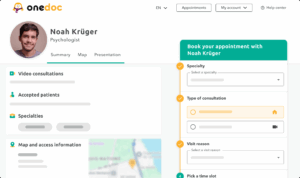
To ensure you don’t start at a loss, offer OneDoc online appointment booking! This way, patients can book time slots in advance for your opening day!
Step 5: Find and set up your psychotherapy practice
Choose an accessible location
The location of your future practice is important. Being present in a major city like Lausanne or Geneva makes it easy for patients to consult you onsite, but rental costs will be higher than in rural areas. Ideally, your practice should be:
- Easily accessible by public transport
- Preferably close to other healthcare professionals (to encourage exchanges and referrals)
OneDoc Tip: Also offer remote consultations
Sometimes, your patients simply cannot come to you (anxiety, reduced mobility, relocation). Teleconsultation allows you to offer high-quality support even remotely!
Teleconsultation can also be a major advantage when opening your practice. By offering some consultations via videoconference, you can reduce your startup costs, for example by renting a practice fewer days per week or sharing a space with other professionals.
Create a space that feels comfortable
Interior design plays a major role in the patient’s well-being. Opt for:
- A warm consultation room with good acoustics and soft lighting
- Comfortable furniture (armchairs, sofa…)
- A simple but reassuring waiting room
- Pay attention to sound confidentiality as well (well-insulated doors, background noise, etc.)
The goal is to create a place where you feel good, because this also helps patients feel safe.
Step 6: Billing, fees and income in an independent practice
In your practice, you have three billing methods: via mandatory health insurance (AOS, with medical prescription), via supplementary insurance, or directly with private patients. Many supplementary insurances reduce their coverage, so it is recommended to clarify before therapy begins whether and how it is covered.
What is the salary of a psychotherapist?
Income depends heavily on your workload, fee system, and ongoing costs. A well-managed practice with a stable client base and realistic expenses can generate a solid income. In Switzerland, psychotherapists earn approximately between 100,000 and 122,000 CHF per year.
Keep in mind that the first year may involve fluctuations and planning uncertainties. Adjust your business plan accordingly.
Step 7: Attract your first patients and grow your psychotherapy practice
You may have the most beautiful practice in the world—if no one knows it exists, the momentum will remain fragile. That’s why you need to gain visibility.
Build your online visibility: website, presence on platforms
Today, many patients begin their care journey by typing their problem into Google or searching for a psychotherapist near them.
To increase the chances that they find you in these searches, you can implement:
- An up-to-date Google Business Profile (address, hours, photos, online booking link)
- A clear website showing your approaches, specializations, consultation languages, and availability
- A profile on a platform like OneDoc to appear higher on Google and enable online appointment booking
Rely on your professional network
Building a cooperative network with doctors, other therapists, and institutions can generate patient referrals. Joining professional associations can also help make your practice known and build trust. It also simplifies the patient care pathway.
Build a psychotherapy practice that reflects you
Opening a psychotherapy practice in Switzerland requires time, energy, and a significant amount of administrative work.
With a clear plan, rigorous preparation, and a realistic understanding of legal, administrative, and economic aspects, you give yourself the best chance of launching a practice that is both viable and aligned with your way of supporting patients!