Digitalization in dermatology practices is not a new phenomenon. For years, the specialty has integrated increasingly advanced IT tools and diagnostic equipment.
And yet, the daily life of dermatologists remains under pressure: fully booked schedules, longer waiting times, administrative overload… So the real question is no longer whether to digitalize, but how to do it. In this article, we give you a complete overview of how dermatology practices in Switzerland are going digital and the next steps you can take today.

Dermatology: a specialty already deeply invested in digitalization
Dermatology is a specialty that has historically embraced new technologies. Digital dermatoscopes, lasers, phototherapy equipment and management software are now standard in many practices.
This provides a solid foundation, but, like in many other medical specialties, there is still a lack of tools to support operational organization. That means tools to help you manage schedules, patient flow, resource coordination, and staff absences. This is especially critical in Switzerland, where administrative demands are growing and adding pressure to medical practices. Your dermatology clinic might be digitally equipped on paper but still lack real operational fluidity.
What recurring issues need solving in dermatology?
Several factors can lead to operational challenges in dermatology, such as the wide variety of appointment types and potential misunderstandings from patients. Add to that no-shows, resource coordination difficulties, and the use of multiple tools that don’t communicate with each other.
A wide range of appointment types
A typical day in dermatology can include mole checks, acne, eczema, technical procedures, aesthetic treatments, and post-treatment follow-ups… Each of these requires different time slots and resources. Without a clear structure, it’s easy to fall into a cycle of cascading delays, poorly allocated time slots, and bottlenecks with rooms or equipment.
Dealing with absences and constant rescheduling
Last-minute cancellations and missed appointments are costly in terms of medical time. They also place an invisible burden on your team: calling patients, rescheduling, filling in gaps, re-explaining procedures, reorganising resources.
Managing resources (rooms, equipment, staff)
Some appointments in dermatology require more than just a doctor: they might require an assistant, a dedicated room, or equipment (laser, digital dermatoscope, phototherapy device). If these resources aren’t well coordinated, time is quickly lost: the doctor isn’t available, the equipment is already booked… and so on.
Tool fragmentation
Many practices juggle with several different systems: a patient record system on one side, a separate scheduling tool, manually managed reminders… This fragmentation increases manual tasks, communication issues, and error risks (wrong slot, wrong resource, missing information).
Next steps for digitalizing your dermatology practice
We’ve covered the key challenges you may be facing as a dermatologist. In this section, you’ll discover the concrete steps you can take to digitalize your dermatology practice and how they can help you improve efficiency.
Step 1: Structure and clarify dermatology appointment types
You may already be using online appointment booking in your dermatology practice. When properly configured, it can both meet patient expectations and pre-structure your agenda.
Our first tip: clarify and limit your consultation reasons. Too many options—or unclear labels—can confuse patients and lead to incorrect bookings or poorly allocated time slots.
Take time to evaluate the duration required for each type of visit. This makes it easier to guide patients toward the right appointment. Some visits can also be offered as teleconsultations, saving time for everyone without compromising clinical quality.
This upfront structuring helps prevent overly short or long appointments, misused time slots, or last-minute adjustments that disrupt your schedule.
Step 2: Simplify booking for treatment protocols
When an appointment involves multiple resources, your scheduling system must reflect the operational reality of your practice who is doing what, when, and with which equipment.
That’s where structured booking tools become valuable. A single patient booking can automatically reserve slots in the calendars of your team, rooms, and necessary equipment.
Step 3: Automate what doesn’t need to be done manually
A large part of your administrative workload has no medical value: confirmations, SMS reminders, pre-appointment instructions, cancellation messages, rebooking offers… Automating these steps frees up your team to focus on medical tasks instead of admin.
Step 4: Centralise and connect your digital tools
You may already be using several of the digital tools mentioned in this article. But for the digitalization of your dermatology practice to truly save time, these tools need to work together.
When information must be entered in multiple places, two risks arise: wasted time and increased chances of errors or omissions. Choosing centralized solutions that include all necessary features or that synchronise with your medical software can help avoid these issues.
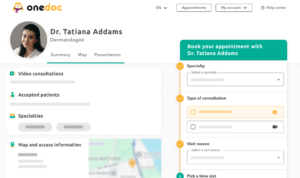
OneDoc features designed for dermatologists

The future of digital dermatology: what role will AI play?
Artificial intelligence is gradually becoming a key player in dermatology digitalization. It’s not here to replace dermatologists, but to support them in specific tasks and help optimise how medical time is used.
In practice, AI already shows promise in dermatological image analysis to support diagnosis, and in generating consultation summaries. These applications, already being tested in other specialties, may soon become part of the daily routine in dermatology practices.
Digitalization in dermatology: a way to get back time for patients
Digitalization in dermatology is not about multiplying tools. It’s about better organising the daily operations of your practice. When done thoughtfully, it leads to a more stable schedule, better coordinated resources, and fewer unnecessary disruptions.
Upcoming innovations, particularly around AI, follow this same goal: to help prepare consultations and assist with specific tasks, so you can preserve medical time.