
Do you want to become a dentist in Switzerland or practice with a diploma obtained abroad? Whether you are considering this career or seeking to have your qualifications recognized, it’s essential to understand the path to becoming a dentist. In Switzerland, the profession is strictly regulated and requires rigorous university training. In this article, discover the key steps to practice as a dentist—whether you are starting your education or seeking diploma validation!

The Dental Profession: A Key Role in Oral Health
Dentists are specialists in the prevention, diagnosis, and treatment of oral diseases. They perform a wide range of procedures, from simple scaling to more complex treatments such as dental implants and orthodontics.
In Switzerland, dentists can work as general dentists or specialize in fields such as:
- Orthodontics: correction of dental misalignments.
- Periodontology: treatment of gum diseases.
- Implantology: placement of dental implants.
- Pediatric dentistry: specific care for children.
The dentist’s role goes beyond treatment. Dentists also have a mission of prevention and education to ensure good oral hygiene for their patients.
Are you a dental hygienist? Discover how to become a dental hygienist in French-speaking Switzerland!
What Studies Are Required to Become a Dentist in Switzerland?
In Switzerland, a complete university program is required to become a dentist. The main universities offering this program are:
- University of Geneva (UniGe)
- University of Lausanne (UniL)
- University of Bern (UniBe)
Admission is based on an application file and may include an aptitude test. Therefore, a high school diploma with a focus on natural sciences is often recommended.
The Structure of Dental Studies
First Phase: Bachelor in Dental Medicine (3 years, 180 ECTS)
This first phase aims to provide essential scientific and preclinical foundations:
- Anatomy, physiology, and histology of the oral cavity
- Biology, biochemistry, and microbiology
- Fundamentals of ergonomics and dental instrumentation
- Introduction to dental imaging techniques
- Prevention and oral hygiene
- Relationship between oral and general health
Second Phase: Master in Dental Medicine (2 years, 120 ECTS)
During the Master’s program, students gain clinical independence and strengthen their expertise:
- Diagnosis and treatment of oral diseases
- Management of complex periodontal cases
- Advanced techniques in prosthodontics and orthodontics
- Emergency dental care management
- Interdisciplinary collaboration in hospital settings
Clinical Internship and Federal Diploma
After obtaining the Master’s degree, a clinical internship is mandatory to validate the federal diploma in dental medicine, which is essential for practice.
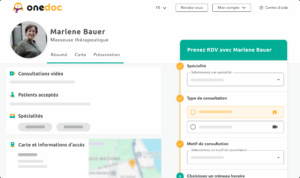
OneDoc Supports Your Dental Practice

Requirements to Practice as a Dentist in Switzerland
Once the federal diploma is obtained, registration with the Medical Professions Commission (MEBEKO) is required to receive authorization to practice.
Recognition of Foreign Diplomas
Dentists trained abroad must have their diplomas validated by the Medical Professions Commission (MEBEKO) to be able to practice in Switzerland.
- If your diploma comes from the European Union (EU) or EFTA, recognition is generally easier thanks to mutual recognition agreements. You must submit a file including your diploma, proof of professional experience, and sometimes a certificate of compliance with European directives.
- If your diploma was obtained outside the EU, the process is more complex and may include an in-depth evaluation, an equivalency exam, or even additional training in Switzerland.
In all cases, the application must be submitted to MEBEKO, which evaluates qualifications and determines any additional steps required to obtain authorization to practice.
What Are the Differences Between Dental Training in Switzerland and Abroad?
Dental studies in Switzerland are distinguished by:
- Limited enrollment: Swiss universities restrict the number of admitted students.
- More hands-on training: hospital internships are integrated very early in the program.
- Higher costs: tuition fees are higher than in France or Italy, where universities are more heavily subsidized.
What Are the Career Prospects for Dentists in Switzerland?
As a dentist in Switzerland, you’ll have the opportunity to work in a dynamic environment and choose whether you prefer to work in:
- A private practice
- A clinic or hospital
- Research centers or universities
The average salary of a dentist in Switzerland is attractive. At the start of a career, a dentist can expect a salary of around 8,000 to 10,000 CHF per month, and with experience, this figure can reach 25,000 CHF per month or more in private practice.
Want to learn more about dentists’ salaries? We have an article that explains everything you need to know about dentist salaries in Switzerland.
Ready to Start Your Dental Career?
You now have all the key information to practice in Switzerland—from university education to administrative procedures. This demanding yet fascinating profession offers excellent prospects and a stimulating work environment.
Why not go further and open your own dental practice? Designing a functional and welcoming space is essential for patient well-being and the efficiency of your practice.
We wish you much success in this rewarding profession!