
In Switzerland, many psychologists choose to practise as independents. This model, often in the form of a private practice, appeals because of the freedom it offers — but it also carries significant responsibilities, both administratively and personally.
Between flexibility, initial investment, patient management, and accounting, you might wonder whether this setup is right for you. Discover in this article the benefits and challenges of a private practice for psychologists.

Private practice or group practice: which to choose?
When you decide to start as a psychologist in Switzerland, one of the first choices is which type of structure you want to use. The private practice, for many advantages it offers — as we’ll see in this article. However, a group practice can also be interesting, especially at the start of a career.
Working in a team allows sharing costs, benefiting from regular exchanges, and enjoying the visibility and shared patient base of a group practice. However, this setup requires more coordination and offers less freedom in certain organizational choices.
Note that you can also opt for a hybrid model — for example renting a room part-time or combining shared practice with telepsychology.
Advantages of the independent psychologist model
High professional flexibility
Working as an independent psychologist means running your activity by your own rules. You thus get to choose:
- Your therapeutic approach
- Your schedule
- The type of patients you wish to support
- Your preferred working rhythm
This flexibility also applies to your place of consultation. Nowadays, many psychologists combine in‑office consultations and teleconsultations, an increasingly adopted practice in Switzerland.
Attractive earning potential
As an independent, your income depends directly on your activity. You set your workload yourself according to your goals and availability. The independent model can thus offer a more advantageous income than an employed position — especially once you have built up your patient base.
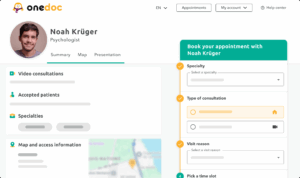
Get patients for your psychology practice with OneDoc

More personalised therapeutic follow‑up
A private practice allows you to create a therapeutic environment tailored to you: setting, rhythm, tools, follow‑up… You can thus build a more personalised relationship with your patients, and develop your own professional identity. More than being fulfilling for you, patients seeking a psychologist appreciate this more personal follow‑up compared to a group practice.
Challenges faced by independent psychologists in Switzerland
Start‑up costs and expenses for opening a private psychology practice
Starting or managing a private practice involves several expenses:
- Rental of a practice space
- Purchase of furniture and equipment
- Professional insurance subscriptions,
- Costs for administrative tools like medical software
These investments and costs can add up quickly, especially if you are starting your practice or not working full-time. On average, expect between to get started.
 Good news: thanks to OneDoc teleconsultation, you can start seeing clients without a dedicated premises — or rent a room only a few days per week. You can then invest in a fixed office once your patient base and income become stable.
Detailed costs to launch your private psychology practice
| Cost item | Short description | Indicative range (CHF) | One‑time / monthly |
|---|---|---|---|
| Business setup (self-employed) | AVS registration, basic formalities | 0 to 500 | One‑time |
| Private practice (rent) | Small city office, utilities included | 800 to 2,000 | Monthly |
| Basic furniture | Desk, chairs, armchair, minimal decor | 1,000 to 4,000 | One‑time |
| IT equipment | Computer, printer, phone | 1,000 to 2,000 | One‑time |
| Management / scheduling software | Booking and billing tool | 100 | Monthly |
| Professional insurance (liability, income loss) | Liability and income coverage | 500 to 1,500 | Per year |
| Website + domain name | Simple site creation + hosting | 500 to 2,000 (creation) + 30 to 150 (annual) | One‑time and per year |
| Marketing (cards, directories…) | Printed materials, directories, social networks | 300 to 1,500 | One‑time / per year |
Emotional burden and isolation of independent psychologists
In a private practice, you are alone with your patients and the emotional load this involves. The absence of a team can lead to a feeling of isolation, especially in complex clinical situations.
However, you can counterbalance this by joining supervision or peer‑support groups for psychologists.
Administrative tasks and accounting
Being an independent psychologist also means managing all the administrative aspects of your activity, including:
- Invoicing
- Accounting
- Social insurance contributions
- Tax declarations
- Payment follow‑up
These tasks can quickly become time‑consuming and a source of stress. So that you can focus on your patients, OneDoc has developed a fee-for-service billing module. With OneDoc Invoice for psychologists, you can bill directly from OneDoc and benefit from many features to help manage your accounting — like payment reminders and bank reconciliation.
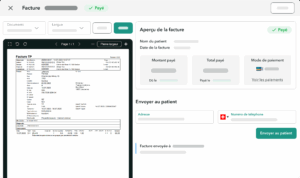
Easily invoice your psychology services with OneDoc
Which legal status to choose in Switzerland as an independent psychologist?
The most common legal form for an independent psychologist is a sole proprietorship, notably for its administrative simplicity. However, other legal forms may also fit such as a LLC (Sàrl) or corporation (SA). Yet these come with higher startup costs.
Preparing well for the challenges of independent psychologists
The model of the independent psychologist remains one of the most common in Switzerland, and for good reasons: flexibility, autonomy, quality of therapeutic follow‑up. But it also comes with challenges — be they administrative, financial, or emotional.
Building a reliable support network, equipping yourself with the right digital tools, and staying informed about Swiss requirements are essential steps to launching your private practice under the best possible conditions.