A missed medical appointment is not always simply a matter of forgetting. Personal circumstances, transportation difficulties, the time between booking and the consultation, and other factors can all explain why a patient does not show up.
For your practice, understanding these different causes helps you take the right action: remind patients when they might forget an appointment, make cancellation easy when they can no longer attend, and fill newly available slots as soon as possible.
Why do patients miss medical appointments?
Research into missed appointments shows there is no single cause. A systematic review in primary care identified forgetfulness, work or family commitments, and transportation difficulties among the reasons frequently reported.
The appointment was forgotten
Remembering an appointment booked several weeks in advance involves what is known as prospective memory: the ability to remember to do something in the future.
That intention has to stay in mind despite the many demands of daily life. Work, family, travel, and other appointments can gradually push the consultation out of focus.
In these cases, a no-show does not necessarily mean the patient did not care about the appointment. The patient intended to attend, but the appointment simply did not come to mind at the right time.
This is exactly when a reminder can help.
The patient’s circumstances have changed since booking
A patient may remember an appointment perfectly well, yet it may no longer fit their circumstances.
Several weeks may pass between booking and the consultation. During that time, a new work commitment may arise, travel plans may change, or symptoms may evolve.
The further away an appointment is, the more time there is for circumstances to change. In these cases, the ideal approach is to make it easy for patients to take action when an appointment no longer works for them.
An unexpected work, family, or practical issue came up
A medical appointment sometimes conflicts with circumstances that are difficult to anticipate: schedule changes, childcare needs, caring for a family member, or transportation problems.
Recent research also highlights how multiple factors contribute to missed appointments. Mobility constraints, competing priorities, and limited flexibility in the time or location of a consultation can all play a role.
Not all of these issues can be resolved with an appointment reminder system.
The patient knows they cannot attend but does not cancel
A patient may know they cannot attend but still fail to notify the practice. This is an important distinction! They may need to find the reception desk’s phone number, call during office hours, or put off contacting the practice. An intention to cancel can then turn into a no-show.
Making cancellation information easy to find benefits your practice. After all, an appointment canceled in advance is a slot you may be able to offer to someone else, whereas a no-show is simply lost appointment time.
A missed appointment is not always a matter of forgetfulness
As we have seen, missed appointments can have several causes, but the outcome for your practice is the same: an unused time slot.
To reduce no-shows over the long term, you can use three strategies.
- Bring the appointment back to the patient’s attention at the right time
- Make it easy to cancel if their circumstances change
- Fill newly available appointment slots quickly
How can you reduce missed medical appointments?
Send a reminder before the appointment
Reminders are among the best-documented ways to address missed appointments. Studies show that SMS messages, phone calls, and other reminder systems can improve attendance rates.
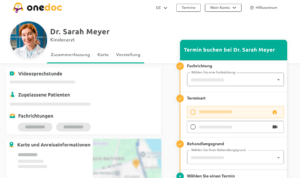
With OneDoc, when an appointment is booked online, a confirmation email is sent within minutes of booking, followed by an SMS reminder 24 hours before the appointment. The reminder is automatic, so your reception staff do not have to send one manually for each consultation.
Digitize your practice with OneDoc

Make it easy to cancel when a patient cannot attend
A reminder should do more than tell patients to show up. It can also remind them that an appointment is still booked even though their circumstances have changed.
For appointments booked online through OneDoc, patients can cancel from their account or directly from the confirmation email. Online cancellation is available up to 24 hours before the scheduled appointment. After that, patients must contact the practice directly.
This helps address one cause of no-shows: patients do not necessarily need to wait for the reception desk to open to let the practice know they cannot attend.
Make canceled appointment slots available again
An early cancellation only benefits your practice if, depending on how your practice operates, the slot can be:
- Made available for online booking again
- Offered to a patient who needs an earlier appointment
- Filled using a waiting list
Can online appointment booking reduce no-shows?
Online booking alone cannot prevent missed appointments. Its real value lies in the patient journey you can build around the appointment: booking, confirmation, reminders, and cancellation management.
How can you track missed appointments at your practice?
Your no-show rate is a useful starting metric. You can calculate it as follows:
No-show rate = number of missed appointments ÷ total number of scheduled appointments × 100
However, an overall rate does not always reveal the cause. It is often more useful to check whether no-shows vary by:
- Time between booking and the appointment
- Appointment type
- Day or time
- Booking method
- Whether a reminder was sent
These data can help you distinguish a practice-wide problem from one concentrated in certain types of consultation or scheduling patterns. To estimate the costs, try our no-show cost calculator.


*The results shown are indicative estimates, based on results observed in practices using OneDoc reminders. They are not a guarantee: the actual reduction in missed appointments and the revenue recovered depend on your activity, your patients and how your practice is organised.
Can no-shows be eliminated entirely?
No. Some circumstances are impossible to predict, such as sudden illness, transportation problems, or a family or work emergency.
The realistic goal is not to eliminate every no-show. It is to reduce forgotten appointments and, whenever possible, turn foreseeable no-shows into cancellations early enough for your practice to manage them.
Frequently asked questions
Why do patients forget their medical appointments?
An appointment booked far in advance may gradually slip from a patient’s mind, especially as other obligations compete for their attention. Forgetfulness is frequently cited in research on missed appointments, but it is not the only cause.
Do SMS reminders reduce missed appointments?
Overall, studies show that reminder systems improve appointment attendance. Their effectiveness varies by context and appointment type.
When does OneDoc send appointment reminders?
For appointments booked online through OneDoc, patients receive a confirmation email after booking and an SMS reminder 24 hours before their appointment.
Can patients cancel a OneDoc appointment without calling the practice?
For appointments booked online, patients can cancel through their OneDoc account or the confirmation email up to 24 hours before the scheduled time. After that, they must contact the practice directly.
Sources
-
Parsons J, Abel G, Mounce LT, Atherton H. The changing face of missed appointments. Br J Gen Pract. 2023 Feb 23;73(728):134-135. doi: 10.3399/bjgp23X732249.
- McLean SM, Booth A, Gee M, Salway S, Cobb M, Bhanbhro S, Nancarrow SA. Appointment reminder systems are effective but not optimal: results of a systematic review and evidence synthesis employing realist principles. Patient Prefer Adherence. 2016 Apr 4;10:479-99. doi: 10.2147/PPA.S93046.
- Swiss healthcare access statistics (Federal Statistical Office)