[](https://info.onedoc.ch/en/)
- [Software](#)
- [OneDoc Hub](https://info.onedoc.ch/en/hub/)
- [OneDoc Profile](https://info.onedoc.ch/en/hub/onedoc-profile/)
- [Online appointment bookingPopular](https://info.onedoc.ch/en/hub/online-booking/)
- [Book online button on GooglePopular](https://info.onedoc.ch/en/hub/book-online-google-button/)
- [Partner healthcare platforms](https://info.onedoc.ch/en/hub/partner-healthcare-platform/)
- [WidgetPopular](https://info.onedoc.ch/en/hub/widget/)
- [Medical agenda](https://info.onedoc.ch/en/hub/medical-agenda/)
- [Step-by-steps appointments](https://info.onedoc.ch/en/hub/step-by-step-appointment/)
- [Medical resources management](https://info.onedoc.ch/en/hub/medical-resources-management/)
- [Referral](https://info.onedoc.ch/en/hub/referral/)
- [SMS reminder for booked appointmentPopular](https://info.onedoc.ch/en/hub/sms-reminders/)
- [Confirmation email](https://info.onedoc.ch/en/hub/confirmation-email/)
- [Consultation notes](https://info.onedoc.ch/en/hub/consultation-notes/)
- [Follow-up appointment recallNew](https://info.onedoc.ch/en/hub/follow-up-appointment-recall/)
- [OneDoc Invoice](https://info.onedoc.ch/en/invoice/)
- [Tarif 590Popular](https://info.onedoc.ch/en/invoice/tarif-590/)
- [Physio TarifPopular](https://info.onedoc.ch/en/invoice/physio-tarif/)
- [PsyTarif (581/582)Coming soon](https://info.onedoc.ch/en/invoice/psytarif/)
- [Swiss Dental Hygienist (SDH) Tarif](https://info.onedoc.ch/en/invoice/tarif-sdh/)
- [Tarif 595Coming soon](https://info.onedoc.ch/en/tarif-595/)
- [CovercardNew](https://info.onedoc.ch/en/invoice/covercard/)
- [QR-bill](https://info.onedoc.ch/en/invoice/qr-bills/)
- [Secure invoice transmission to the patient (TG)](https://info.onedoc.ch/en/invoice/third-party-guarantor/)
- [Invoice transmission to the insurance (TP)](https://info.onedoc.ch/en/invoice/third-party-payment/)
- [Payment reminders](https://info.onedoc.ch/en/invoice/payment-reminders/)
- [Payment reconciliation](https://info.onedoc.ch/en/invoice/automatic-payment-reconciliation/)
- [Year-end closing](https://info.onedoc.ch/en/invoice/year-end-closing/)
- [VAT return](https://info.onedoc.ch/en/invoice/vat-return/)
- [Statistics](https://info.onedoc.ch/en/invoice/statistics/)
- [Emma: AI Phone AssistantSoon available](https://info.onedoc.ch/en/emma-phone-assistant/)
- [OneDoc LinkNew](https://info.onedoc.ch/en/link/)
- [OneDoc InboxSoon available](https://info.onedoc.ch/en/inbox/)
- [Medication requestsNew](https://info.onedoc.ch/en/inbox/medication-requests/)
- [OneDoc Visio](https://info.onedoc.ch/en/visio/)
- [Teleconsultation badge](https://info.onedoc.ch/en/visio/teleconsultation-badge/)
- [Teleconsultation modulePopular](https://info.onedoc.ch/en/visio/teleconsultation-module/)
- [Screen sharing](https://info.onedoc.ch/en/visio/screen-sharing/)
- [Professional background for teleconsultation](https://info.onedoc.ch/en/visio/background-teleconsultation/)
- [Audio and Video settings](https://info.onedoc.ch/en/visio/audio-video-setting/)
- [Solutions](#)
- [Your needs](https://info.onedoc.ch/en/needs/)
- [Increase your visibility](https://info.onedoc.ch/en/needs/increase-visibility/)
- [Get more new patients](https://info.onedoc.ch/en/needs/get-new-patients/)
- [Retain your patientsPopular](https://info.onedoc.ch/en/needs/retain-your-patients/)
- [Automate the follow-up of your existing patients](https://info.onedoc.ch/en/needs/automate-follow-up-existing-patients/)
- [Manage care protocols easily](https://info.onedoc.ch/en/needs/manage-care-protocols/)
- [Keep your patients in your network](https://info.onedoc.ch/en/needs/keep-patients-network/)
- [Easily refer your patientsPopular](https://info.onedoc.ch/en/needs/refer-your-patients/)
- [Receive qualified referrals](https://info.onedoc.ch/en/needs/receive-qualified-referrals/)
- [Handle more patient requests](https://info.onedoc.ch/en/needs/handle-more-patient-requests/)
- [Limit the number of no-showsPopular](https://info.onedoc.ch/en/needs/reduce-no-shows/)
- [Reduce the number of incoming callsPopular](https://info.onedoc.ch/en/needs/reduce-incoming-calls/)
- [Stay connected with your patients](https://info.onedoc.ch/en/needs/stay-connected-with-patients/)
- [Create and manage your invoices](https://info.onedoc.ch/en/needs/create-compliant-invoices/)
- [Your specialty](https://info.onedoc.ch/en/specialty/)
- [General practitioner](https://info.onedoc.ch/en/specialty/general-practitioner/)
- [SpecialistPopular](https://info.onedoc.ch/en/specialty/specialist/)
- [Dentist](https://info.onedoc.ch/en/specialty/dentist/)
- [Dental hygienist](https://info.onedoc.ch/en/specialty/dental-hygienist/)
- [Physiotherapist](https://info.onedoc.ch/en/specialty/physiotherapist/)
- [Therapist](https://info.onedoc.ch/en/specialty/therapist/)
- [PsychologistPopular](https://info.onedoc.ch/en/specialty/psychologist/)
- [Psychotherapists](https://info.onedoc.ch/en/specialty/psychotherapists/)
- [Ophthalmologist](https://info.onedoc.ch/en/specialty/ophthalmologist/)
- [Dermatologist](https://info.onedoc.ch/en/specialty/dermatologist/)
- [Pediatrician](https://info.onedoc.ch/en/specialty/pediatrician/)
- [Gynecologists](https://info.onedoc.ch/en/specialty/gynecologists/)
- [Aesthetic medicine](https://info.onedoc.ch/en/specialty/aesthetic-medicine/)
- [Your healthcare facility](https://info.onedoc.ch/en/specialty/)
- [Medical center](https://info.onedoc.ch/en/specialty/medical-center/)
- [Hospital](https://info.onedoc.ch/en/specialty/hospital/)
- [Pharmacy](https://info.onedoc.ch/en/specialty/pharmacy/)
- [Imaging center](https://info.onedoc.ch/en/specialty/imaging-center/)
- [Medical laboratory](https://info.onedoc.ch/en/specialty/medical-laboratory/)
- [Hearing care professional](https://info.onedoc.ch/en/specialty/hearing-care-professionals/)
- [Optician](https://info.onedoc.ch/en/specialty/optician/)
- [Connectors](#)
- [A-D](#)
- [Aeskulap](https://info.onedoc.ch/en/connectors/aeskulap/)
- [amétiq siMed](https://info.onedoc.ch/en/connectors/ametiq-simed/)
- [Axenita](https://info.onedoc.ch/en/connectors/axenita-axonlab/)
- [Carefolio](https://info.onedoc.ch/en/connectors/carefolio/)
- [curaMED](https://info.onedoc.ch/en/connectors/curamed/)
- [Delemed](https://info.onedoc.ch/en/connectors/delemed/)
- [DentaGest](https://info.onedoc.ch/en/connectors/dentagest/)
- [Denteo](https://info.onedoc.ch/en/connectors/denteo/)
- [E-G](#)
- [E-Medicus](https://info.onedoc.ch/en/connectors/e-medicus/)
- [E-PAT](https://info.onedoc.ch/en/connectors/e-pat/)
- [ElexisNew](https://info.onedoc.ch/en/connectors/elexis/)
- [ePaad](https://info.onedoc.ch/en/connectors/epaad/)
- [ePhysio](https://info.onedoc.ch/en/connectors/ephysio/)
- [ergodent](https://info.onedoc.ch/en/connectors/ergodent/)
- [Eyesoft](https://info.onedoc.ch/en/connectors/eyesoft/)
- [Google Calendar](https://info.onedoc.ch/en/connectors/google-calendar/)
- [H-M](#)
- [Handylife](https://info.onedoc.ch/en/connectors/handy-patients/)
- [Hexabit Luna](https://info.onedoc.ch/en/connectors/hexabit-luna/)
- [ifaNew](https://info.onedoc.ch/en/connectors/ifa/)
- [KISIM](https://info.onedoc.ch/en/connectors/cistec-kisim/)
- [Liris](https://info.onedoc.ch/en/connectors/liris/)
- [Medes](https://info.onedoc.ch/en/connectors/medes/)
- [MediCloud](https://info.onedoc.ch/en/connectors/medicloud/)
- [MediOnline](https://info.onedoc.ch/en/connectors/medionline-aerztekasse/)
- [Mediway](https://info.onedoc.ch/en/connectors/mediway/)
- [N-Q](#)
- [NereidaNew](https://info.onedoc.ch/en/connectors/nereida/)
- [NEXUS](https://info.onedoc.ch/en/connectors/nexus/)
- [Oplus](https://info.onedoc.ch/en/connectors/oplus/)
- [Outlook](https://info.onedoc.ch/en/connectors/outlook/)
- [PhysioApp](https://info.onedoc.ch/en/connectors/physioapp/)
- [Polavis](https://info.onedoc.ch/en/connectors/polavis/)
- [Polypoint](https://info.onedoc.ch/en/connectors/polypoint/)
- [PraxinovaNew](https://info.onedoc.ch/en/connectors/praxinova/)
- [ProPharma](https://info.onedoc.ch/en/connectors/propharma/)
- [Pulse Medica](https://info.onedoc.ch/en/connectors/pulse-medica/)
- [R-Z](#)
- [RockethealthNew](https://info.onedoc.ch/en/connectors/rockethealth/)
- [SOFTplus](https://info.onedoc.ch/en/connectors/softplus/)
- [Sokle](https://info.onedoc.ch/en/connectors/sokle/)
- [tomedoNew](https://info.onedoc.ch/en/connectors/tomedo/)
- [Vitomed](https://info.onedoc.ch/en/connectors/vitomed-vitodata/)
- [WinLogie](https://info.onedoc.ch/en/connectors/winlogie/)
- [WinMed](https://info.onedoc.ch/en/connectors/winmed/)
- [ZaWin](https://info.onedoc.ch/en/connectors/zawin/)
- [See all our connectors](https://info.onedoc.ch/en/connectors/)
- [Resources](#)
- [About OneDoc](#)
- [Our Mission](https://info.onedoc.ch/en/our-mission/)
- [Media](https://info.onedoc.ch/en/media/)
- [Blog](https://info.onedoc.ch/en/blog/)
- [For general practitioners](https://info.onedoc.ch/en/blog/doctors/)
- [For dentists](https://info.onedoc.ch/en/blog/dentists/)
- [For dental hygienists](https://info.onedoc.ch/en/blog/dental-hygienists/)
- [For pediatricians](https://info.onedoc.ch/en/blog/pediatricians/)
- [For ophtalmologists](https://info.onedoc.ch/en/blog/ophtalmologists/)
- [For medical center](https://info.onedoc.ch/en/blog/medical-center/)
- [For pharmacy](https://info.onedoc.ch/en/blog/pharmacy/)
- [For physiotherapists](https://info.onedoc.ch/en/blog/physiotherapists/)
- [For psychologists](https://info.onedoc.ch/en/blog/psychologists/)
- [For complementary therapists](https://info.onedoc.ch/en/blog/therapists/)
- [Resources](#)
- [ROI Calculator](https://info.onedoc.ch/en/profitability-calculator/)
- [Feature QuizNew](https://info.onedoc.ch/en/feature-quiz/)
- [Online visibility audit](https://info.onedoc.ch/en/online-visibility-audit/)
- [Patient Journey Scan](https://info.onedoc.ch/en/patient-journey-scan/)
- [EN](https://info.onedoc.ch/en/blog/all-specialties/ai-medical-practitioners/)
- [FR](https://info.onedoc.ch/fr/blog/toutes-les-specialites/ia-secretariat-medical/ "Switch to FR (FR)")
- [DE](https://info.onedoc.ch/de/blog/alle-fachgebiete/ki-medizinische-sekretariate/ "Switch to DE (DE)")
- [IT](https://info.onedoc.ch/it/blog/tutte-le-specialita/ia-alleggerire-lavoro-medici/ "Switch to IT (IT)")
[Book a demo](https://info.onedoc.ch/en/discover-onedoc-pro/) [Book an appointment](https://www.onedoc.ch/en/)
[OneDoc Pro](https://info.onedoc.ch/en/ "Go to OneDoc Pro.") [Blog](https://info.onedoc.ch/en/blog/ "Go to Blog.") [All specialties](https://info.onedoc.ch/en/blog/all-specialties/ "Go to the All specialties Category archives.") Can AI ease the workload of medical practitioners and front-desk teams? And how?
# Can AI ease the workload of medical practitioners and front-desk teams? And how?
28/04/2026 [All specialties](https://info.onedoc.ch/en/blog/all-specialties/)
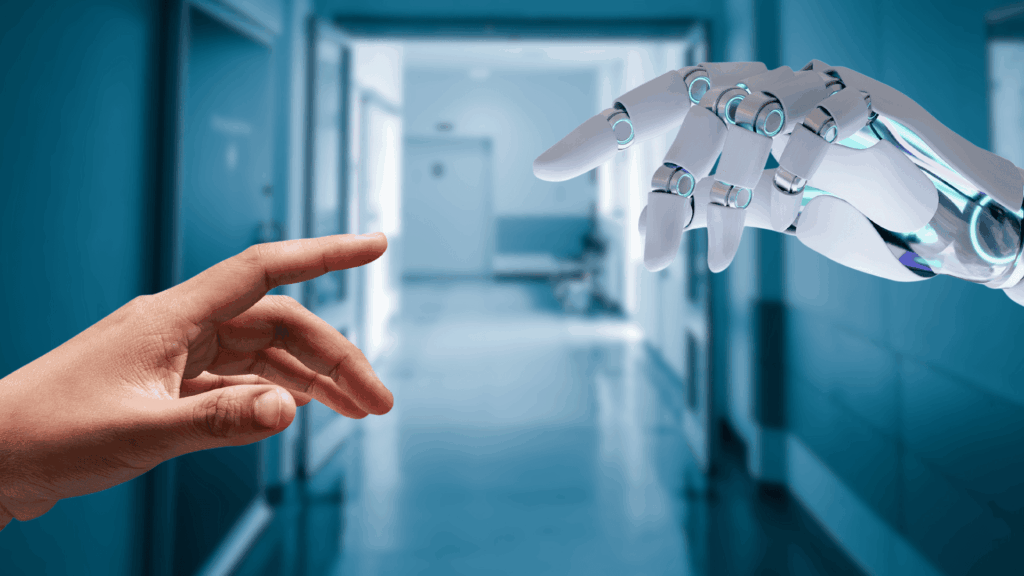
Calls, reports, requests to handle: in a medical practice, __administrative workload is taking up an increasingly large share of your daily routine__. When it builds up, it is not only your organization that comes under strain, but also the time available for your patients.
In this context, AI is attracting growing interest. However, one question comes up again and again: __can it really reduce the administrative burden without compromising the quality of care?__
###  [Discover OneDoc for medical practices](https://info.onedoc.ch/en/specialty/medical-center/)
## Is AI really everywhere?
Today, a lot of things are being grouped under the term AI. Because it is a trendy term, it is often associated with all kinds of solutions and developments. In many cases, however, it is simply traditional automation: a rule triggers an action. __That is not the same as a tool that can understand a request, summarize an exchange, or generate text.__
In a medical context, however, this is exactly where AI becomes interesting. Artificial intelligence becomes valuable when it helps process less structured information: __a phone call, a consultation note, a draft reply, or a report that needs to be rewritten__.
## How AI can help reduce your administrative workload
### Reduce the need for daily writing
One of the first uses of AI, and probably the best known, is writing assistance. In a medical context, you can use LLMs (conversational AI models such as ChatGPT or Claude) to:
- Prepare an email draft
- Rewrite practical information
- Structure a message
These tasks quickly become time-consuming and offer little added value. Artificial intelligence allows you to complete them more quickly. Of course, AI does not replace human validation. It prepares a starting point and __saves you time on the form__, without replacing the substance that you provide.
### Manage incoming requests more efficiently
At the front desk, a major source of lost time comes from phone calls that interrupt ongoing work:
- Appointment changes
- New bookings
- Prescription requests
- Questions about documents to send or prepare
__These requests are not always complex, but each one interrupts the task currently in progress.__ On top of that, they create constant context switching, which is tiring, slows work down, and increases the risk of mistakes.
In this area, some tools can answer the phone during busy periods, when the practice is closed, or simply to handle these simple requests.
#### Be among the first users of Emma, your medical practice’s virtual assistant.
Emma can help you with:
- __Appointment booking__
- __Prescription renewals__
- __Sharing practical information__
[Discover Emma](https://info.onedoc.ch/fr/emma-assistant-telephonique/)

### Help with documentation and note-taking
In some situations, artificial intelligence tools can help __format a note, prepare a draft report, or make transcription work easier__.
During the consultation, this allows you to focus fully on the patient relationship, your interactions, and all the nonverbal cues that are useful to your assessment, without having to focus on note-taking. The FMH cites the optimization of administrative processes among the practical uses of AI in healthcare.
## How to choose the right AI solution for your medical practice
### Start with your problem, not the technology
Many tools already exist, and many more will certainly arrive soon. To make sense of this jungle of AI solutions, the first step is to clearly identify your needs. Which repetitive, time-consuming, low-value tasks are making you lose time every day? Which tasks or actions do you think could be optimized? From there, you can define whether you want to:
- Reduce missed calls
- Limit interruptions at the front desk
- Save time writing reports
- Better structure incoming requests

#### Digitize your practice with OneDoc
| | |
|-----------------------------------------------------------------------------------------------------------------------------------------|---------------------------------------------------------------------------------------------------------------------------|
|  [Emma](https://info.onedoc.ch/en/emma-phone-assistant/) |  [Inbox](https://info.onedoc.ch/en/inbox/) |
|  [Online appointment booking](https://info.onedoc.ch/en/hub/online-booking/) |  [SMS reminders](https://info.onedoc.ch/en/hub/sms-reminders/) |
[Book a demo](# "OneDoc Beratung")
### Choose a solution that fits into your practice without adding to the workload
A solution may seem very promising, but in the end it can add more work to your daily routine.
If it forces the team to manually reprocess every request, or if it is not compatible with your existing software or processes, the benefit will be limited. __The right choice is not always the most comprehensive solution. It is the one that offers the best balance between usefulness and simplicity.__
### Make sure data is secure
__Health data is considered sensitive personal data under Swiss law.__ It therefore requires a higher level of protection. Whatever solution you use, you need to make sure that you:
- Comply with professional confidentiality / __medical confidentiality__
- __Restrict access to data__ to what is strictly necessary
- Check __who receives the data and where it is sent__
- Ensure that the data __is not transferred abroad__ without appropriate safeguards
- Ensure that the use of the tool remains __compatible with medical ethics__
### Keep human oversight
Whatever tool you use, it is essential to always be able to verify what the AI produces. The FMH also stresses this point: tools of this kind should be used in situations where you and your team are able __to spot an error, assess the quality of the result, and remain in control__.
## How can you measure the impact of AI in your medical practice on your medical front desk?
Implementing an AI tool can come at a cost, which is why it is important to measure whether it brings real value to your practice. Here are the indicators you can monitor:
| Indicator | Objective | Measure / Impact |
|---------------------------------|-------------------------------------------------------------------|---------------------------------------------------|
| Missed calls | Reduction or even elimination of unanswered calls | Fewer lost calls, better accessibility |
| Time before first response | Immediate handling of calls | Shorter response time |
| Interruptions at the front desk | Significant decrease in interruptions during patient interactions | Fewer interruptions, better front-desk experience |
| Satisfaction with accessibility | Improved patient experience | Patient feedback or a short survey |
## Finding the right balance without losing the human touch
AI is not meant to replace a front desk team, nor to come between caregivers and patients.
However, it can become a valuable support when it is used where it is most useful: __for repetitive administrative tasks, structuring requests, first-level drafting, and information flow.__
The benefit is not only organizational. It is also human. __Less repetitive workload means more time for situations that require attention, coordination, and listening.__
###  [Talk to our advisors and discover how OneDoc can reduce your practice’s workload](#)
## Sources
- [FMH. Understanding large language models](https://www.fmh.ch/fr/themes/ehealth/tendances-et-technologies/ia-generative/les-grands-modeles.cfm)
- [FMH. Legal considerations](https://www.fmh.ch/fr/themes/ehealth/tendances-et-technologies/ia-generative/considerations-juridiques.cfm)
- [FMH. Examples of practical applications in healthcare](https://www.fmh.ch/fr/themes/ehealth/tendances-et-technologies/ia-generative/exemples-applications-pratique.cfm)
- [FMH. FMH recommendations on the use of large language models (LLMs) in everyday medical practice](https://www.fmh.ch/fr/themes/ehealth/tendances-et-technologies/ia-generative/recommandations-de-la-fmh.cfm)
- [FMH, & Swiss Academy of Medical Sciences. 7.1 Professional secrecy. In Legal foundations for everyday medical practice: Practical guide](https://leitfaden.samw.fmh.ch/fr/guide-pratique-bases-juridique/7-secret-medical-rapports/71-secret-professionnel-medeci.cfm)
- [FMH. (2024). Swiss Medical Journal, Issue 21/2024. EMH Swiss Medical Publishers.](https://www.fmh.ch/files/pdf30/saez-bms-2024-21-de.pdf)
- [Graf et al. (2021). Breakthrough, potential, and responsibility: On the future of legal education. Dike Verlag.](https://www.dike.ch/media/productattachment/0/2296/978-3-03929-006-2_GrafHauxPicecchiRitterSpirig_Aufbruch.pdf)
- [Qin et al. (2025). Customer service representative’s perception of the AI assistant in an organization’s call center](https://arxiv.org/abs/2507.00513)
- [Federal Data Protection and Information Commissioner. Transfer of data abroad](https://www.edoeb.admin.ch/fr/communication-de-donnees-a-letranger)
- [Rosenfluh Publikationen AG. (2025). Ars Medici, 15/2025: Swiss Journal of General Practice](https://www.rosenfluh.ch/ars-medici-15_2025_low)
[](https://www.google.com/preferences/source?q=onedoc.ch)
[](https://www.facebook.com/sharer/sharer.php?u=https%3A%2F%2Finfo.onedoc.ch%2Fen%2Fblog%2Fall-specialties%2Fai-medical-practitioners%2F "Share on Facebook")[](https://x.com/intent/post?url=https%3A%2F%2Finfo.onedoc.ch%2Fen%2Fblog%2Fall-specialties%2Fai-medical-practitioners%2F "Share on X")[](https://www.linkedin.com/shareArticle?mini=true&url=https%3A%2F%2Finfo.onedoc.ch%2Fen%2Fblog%2Fall-specialties%2Fai-medical-practitioners%2F "Share on LinkedIn")
##### About OneDoc
- [Our Mission](https://info.onedoc.ch/en/our-mission/)
- [Privacy policy](https://privacy.onedoc.ch/fr)
- [Cookie policy](https://info.onedoc.ch/en/cookie-policy/)
- [Visual credits and copyright](https://info.onedoc.ch/en/visual-credits-and-copyright/)
[Consent management](javascript:Didomi.preferences.show%28%29)
##### Our websites
- [pro.onedoc.ch: app for healthcare professionals](https://pro.onedoc.ch/fr/)
- [onedoc.ch: online booking platform](https://www.onedoc.ch/fr/)
- [myhealth.onedoc.ch: health blog](https://myhealth.onedoc.ch/fr/)
##### Languages
- [FR](https://info.onedoc.ch/fr/blog/toutes-les-specialites/ia-secretariat-medical/ "Switch to FR (FR)")
- [DE](https://info.onedoc.ch/de/blog/alle-fachgebiete/ki-medizinische-sekretariate/ "Switch to DE (DE)")
- [IT](https://info.onedoc.ch/it/blog/tutte-le-specialita/ia-alleggerire-lavoro-medici/ "Switch to IT (IT)")
- [EN](https://info.onedoc.ch/en/blog/all-specialties/ai-medical-practitioners/ "Switch to EN (EN)")
##### Our Softwares
- [OneDoc Hub](https://info.onedoc.ch/en/hub/)
- [OneDoc Profile](https://info.onedoc.ch/en/hub/onedoc-profile/)
- [Medical agenda](https://info.onedoc.ch/en/hub/medical-agenda/)
- [Online appointment booking](https://info.onedoc.ch/en/hub/online-booking/)
- [Widget](https://info.onedoc.ch/en/hub/widget/)
- [Partner healthcare platforms](https://info.onedoc.ch/en/hub/partner-healthcare-platform/)
- [Follow-up appointment recall](https://info.onedoc.ch/en/hub/follow-up-appointment-recall/)
- [Confirmation email](https://info.onedoc.ch/en/hub/confirmation-email/)
- [Book online button on Google](https://info.onedoc.ch/en/hub/book-online-google-button/)
- [Step-by-steps appointments](https://info.onedoc.ch/en/hub/step-by-step-appointment/)
- [Medical resources management](https://info.onedoc.ch/en/hub/medical-resources-management/)
- [Referral](https://info.onedoc.ch/en/hub/referral/)
- [Statistics on your activity](https://info.onedoc.ch/en/invoice/statistics/)
- [Consultation notes](https://info.onedoc.ch/en/hub/consultation-notes/)
- [SMS reminder for booked appointment](https://info.onedoc.ch/en/hub/sms-reminders/)
- [OneDoc Invoice](https://info.onedoc.ch/en/invoice/)
- [Tarif 590](https://info.onedoc.ch/en/invoice/tarif-590/)
- [Physio Tarif](https://info.onedoc.ch/en/invoice/physio-tarif/)
- [PsyTarif (581/582)](https://info.onedoc.ch/en/invoice/psytarif/)
- [SDH Tarif](https://info.onedoc.ch/en/invoice/tarif-sdh/)
- [Tarif 595](https://info.onedoc.ch/en/tarif-595/)
- [QR-bill](https://info.onedoc.ch/en/invoice/qr-bills/)
- [Payment reminders](https://info.onedoc.ch/en/invoice/payment-reminders/)
- [Automatic payment reconciliation](https://info.onedoc.ch/en/invoice/automatic-payment-reconciliation/)
- [VAT return](https://info.onedoc.ch/en/invoice/vat-return/)
- [Secure invoice transmission to the patient (TG)](https://info.onedoc.ch/en/invoice/third-party-guarantor/)
- [Invoice transmission to the insurance (TP)](https://info.onedoc.ch/en/invoice/third-party-payment/)
- [Year-end closing](https://info.onedoc.ch/en/invoice/year-end-closing/)
- [Covercard](https://info.onedoc.ch/en/invoice/covercard/)
- [Emma, your virtual phone assistant](https://info.onedoc.ch/en/emma-phone-assistant/)
- [OneDoc Inbox](https://info.onedoc.ch/en/inbox/)
- [Medication requests](https://info.onedoc.ch/en/inbox/medication-requests/)
- [OneDoc Link](https://info.onedoc.ch/en/link/)
- [OneDoc Visio](https://info.onedoc.ch/en/visio/)
- [Teleconsultation badge](https://info.onedoc.ch/en/visio/teleconsultation-badge/)
- [Teleconsultation Module](https://info.onedoc.ch/en/visio/teleconsultation-module/)
- [Screen sharing](https://info.onedoc.ch/en/visio/screen-sharing/)
- [Professional background for teleconsultation](https://info.onedoc.ch/en/visio/background-teleconsultation/)
- [Audio and Video settings](https://info.onedoc.ch/en/visio/audio-video-setting/)
##### Use case
- [Create and manage your invoices with OneDoc Invoice](https://info.onedoc.ch/en/needs/create-compliant-invoices/)
- [Retain your patients with a smooth and convenient digital experience](https://info.onedoc.ch/en/needs/retain-your-patients/)
- [Increase the visibility of your practice](https://info.onedoc.ch/en/needs/increase-visibility/)
- [Get more new patients](https://info.onedoc.ch/en/needs/get-new-patients/)
- [Manage care protocols easily](https://info.onedoc.ch/en/needs/manage-care-protocols/)
- [Keep your patients within your network](https://info.onedoc.ch/en/needs/keep-patients-network/)
- [Easily refer your patients to specialists in your network](https://info.onedoc.ch/en/needs/refer-your-patients/)
- [Receive qualified referrals from trusted colleagues](https://info.onedoc.ch/en/needs/receive-qualified-referrals/)
- [Limit the number of no-shows](https://info.onedoc.ch/en/needs/reduce-no-shows/)
- [Handle more patient requests](https://info.onedoc.ch/en/needs/handle-more-patient-requests/)
- [Reduce the number of incoming calls](https://info.onedoc.ch/en/needs/reduce-incoming-calls/)
- [Stay connected with your patients](https://info.onedoc.ch/en/needs/stay-connected-with-patients/)
- [Automate the follow-up of your existing patients](https://info.onedoc.ch/en/needs/automate-follow-up-existing-patients/)
##### Our solutions by specialty
- [General practitioner](https://info.onedoc.ch/en/specialty/general-practitioner/)
- [Specialist](https://info.onedoc.ch/en/specialty/specialist/)
- [Dentist](https://info.onedoc.ch/en/specialty/dentist/)
- [Dental hygienist](https://info.onedoc.ch/en/specialty/dental-hygienist/)
- [Physiotherapist](https://info.onedoc.ch/en/specialty/physiotherapist/)
- [Therapist](https://info.onedoc.ch/en/specialty/therapist/)
- [Psychologist](https://info.onedoc.ch/en/specialty/psychologist/)
- [Psychotherapists](https://info.onedoc.ch/en/specialty/psychotherapists/)
- [Ophthalmologist](https://info.onedoc.ch/en/specialty/ophthalmologist/)
- [Dermatologist](https://info.onedoc.ch/en/specialty/dermatologist/)
- [Pediatrician](https://info.onedoc.ch/en/specialty/pediatrician/)
- [Gynecologists](https://info.onedoc.ch/en/specialty/gynecologists/)
- [Aesthetic medicine](https://info.onedoc.ch/en/specialty/aesthetic-medicine/)
##### Our solutions by type of medical facility
- [Medical center](https://info.onedoc.ch/en/specialty/medical-center/)
- [Hospital](https://info.onedoc.ch/en/specialty/hospital/)
- [Pharmacy](https://info.onedoc.ch/en/specialty/pharmacy/)
- [Imaging center](https://info.onedoc.ch/en/specialty/imaging-center/)
- [Medical laboratory](https://info.onedoc.ch/en/specialty/medical-laboratory/)
- [Hearing care professional](https://info.onedoc.ch/en/specialty/hearing-care-professionals/)
- [Optician](https://info.onedoc.ch/en/specialty/optician/)
##### Resources
- [Blog](https://info.onedoc.ch/en/blog/)
- [Media](https://info.onedoc.ch/en/media/)
- [ROI Calculator](https://info.onedoc.ch/en/profitability-calculator/)
- [Feature Quiz](https://info.onedoc.ch/en/feature-quiz/)
- [Online visibility audit](https://info.onedoc.ch/en/online-visibility-audit/)
- [Patient Journey Scan](https://info.onedoc.ch/en/patient-journey-scan/)
##### Our latest articles
- [New physiotherapy tariff positions: what will change for you from 1 July 2026](https://info.onedoc.ch/en/blog/physiotherapists/new-tariffs-physiotherapy-2026/)
- [AI in medicine: why your patients are wary (and how transparent communication can restore trust)](https://info.onedoc.ch/en/blog/all-specialties/ai-medicine-build-trust/)
- [Shortage of medical assistants: 3 ways to ease your medical practice’s administrative workload](https://info.onedoc.ch/en/blog/all-specialties/shortage-medical-assistants/)
- [Tarif 595: Are you affected and how does it work?](https://info.onedoc.ch/en/blog/all-specialties/tarif-595-are-you-affected/)
- [Tarif 595: A guide to understanding invoice structure](https://info.onedoc.ch/en/blog/all-specialties/tarif-595-invoice-structure/)
- [Stress and burnout in medical practices: 7 strategies to make your day-to-day easier](https://info.onedoc.ch/en/blog/all-specialties/burnout-medical-practices/)
- [Independent or employed dental hygienist: What are the differences in Switzerland?](https://info.onedoc.ch/en/blog/dental-hygienists/independent-employed-dental-hygienist-differences/)
- [Can AI ease the workload of medical practitioners and front-desk teams? And how?](https://info.onedoc.ch/en/blog/all-specialties/ai-medical-practitioners/)
© 2026 OneDoc SA - Made with  in Switzerland
Close